
Fresh investment announcements rose sharply in Q1-FY2027, covering April-June 2026. The quarter recorded 3,871 new projects worth Rs 14,76,531.33 crore, compared with 3,143 projects worth Rs 8,63,433.54 crore in Q4-FY2026. In value terms, this indicated a quarter-on-quarter increase of 71.01 percent. The number of projects also rose by 23.16 percent, suggesting a wider project pipeline than in the preceding quarter.
However, the growth was concentrated in a small set of very large nuclear power projects announced in Maharashtra in May 2026. Four nuclear projects alone accounted for Rs 6,50,000 crore. These included the Nuclear Power (Purnagad) project of Reliance Industries, the Nuclear Power (Maharashtra) project of Lalitpur Power Generation Company, the Nuclear Power Plant (Barsu) project of Coastal-Maha Atomic Energy, and NTPC’s Nuclear Power (Devgad) project.
The policy background also supported the announcement of these projects. The Sustainable Harnessing and Advancement of Nuclear Energy for Transforming India Act, 2025, known as the SHANTI Act, opened the nuclear power sector to wider participation, including private and foreign participation, subject to government approval. This policy change provided the enabling ground for the announcement of new nuclear investment.
If the above four nuclear projects were kept aside, the investment scenario in Q1-FY2027 would look different. Total fresh investment, after excluding these projects, stood at around Rs 8,26,531 crore, lower than the Rs 8,63,433.54 crore announced in Q4-FY2026. On this adjusted basis, fresh investment declined by 4.27 percent quarter-on-quarter. Thus, the headline increase reflected the effect of a few large projects rather than a broad-based recovery across sectors.
Mega Projects
Mega projects continued to dominate the investment profile. In Q4-FY2026, 128 mega projects, each with a cost of Rs 1,000 crore or more, involved an aggregate investment of Rs 6,61,832.67 crore. In Q1-FY2027, the number of such projects rose to 143 and their aggregate investment increased to Rs 12,06,425.25 crore. Their share in total fresh investment increased from 76.65 percent in Q4-FY2026 to 81.71 percent in Q1-FY2027. This showed that the investment profile remained highly concentrated in large-ticket announcements. Such concentration was not new, but it became more visible in the quarter because of the four nuclear power projects.
By Ownership
By ownership, the Private sector continued to dominate fresh investment. Private investment stood at Rs 10,59,140.81 crore across 1,400 projects, accounting for 71.73 percent of total fresh investment. In Q4-FY2026, the Private sector had announced 1,029 projects worth Rs 6,20,784.26 crore. The apparent increase in private investment was mainly due to the nuclear power projects in Maharashtra. If the three private nuclear power projects worth Rs 5,50,000 crore was excluded from the quarter’s private investment, private investment showed a decline of 31.88 percent over Q4-FY2026.
Private Indian investors accounted for Rs 9,93,589.44 crore, or 67.29 percent of total fresh investment. Large announcements included the nuclear projects of Reliance Industries, Lalitpur Power Generation Company and Coastal-Maha Atomic Energy, Orissa Thermal Energy’s coal-based power project, Shyam Steel Industries’ integrated steel plant, Akshat Greentech’s solar manufacturing project, and Adani Hydro Energy Eleven’s pumped storage hydel project.
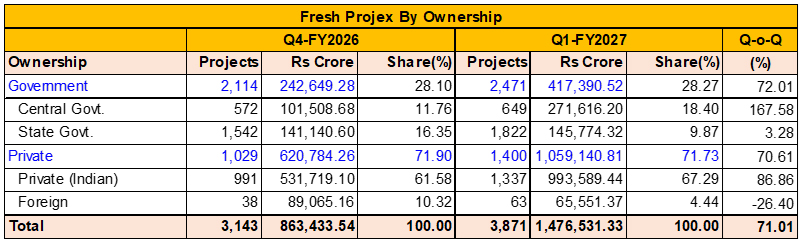
Private Foreign investment declined from Rs 89,065.16 crore in Q4-FY2026 to Rs 65,551.37 crore in Q1-FY2027. Its share fell from 10.32 percent to 4.44 percent. Major Private Foreign projects included Raiden Infotech India’s Artificial Intelligence Data Centre in Andhra Pradesh, Yamko India’s Green Hydrogen project at Tirupati, Greenko Energies’ pumped storage project in Bihar, Amazon Data Services’ data centre project in Telangana, and Hitachi Energy India’s power transformer project in Gujarat.
Government investment increased from Rs 2,42,649.28 crore in Q4-FY2026 to Rs 4,17,390.52 crore in Q1-FY2027. Central Government investment rose sharply to Rs 2,71,616.20 crore, helped by NTPC’s Nuclear Power project at Devgad and railway and road projects. State Government investment recorded only a marginal increase, from Rs 1,41,140.60 crore to Rs 1,45,774.32 crore. Important State Government projects included the Integrated Residential Township at Airoli in Maharashtra, the Eastern Connectivity Tunnel at Bengaluru Airport, and water, road and urban infrastructure projects across states.
By Sectors
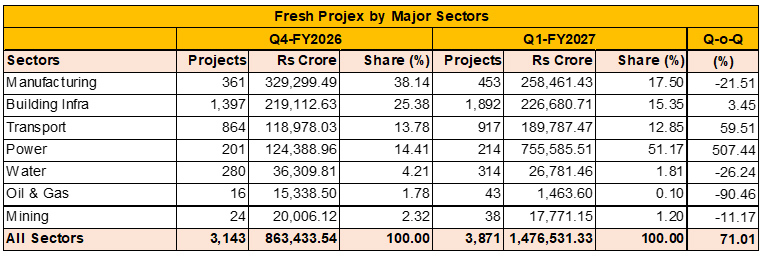
Among major sectors, Power emerged as the largest recipient of fresh investment in Q1-FY2027. The sector attracted 214 projects worth Rs 7,55,585.51 crore, accounting for 51.17 percent of total fresh investment. In Q4-FY2026, Power had recorded 201 projects worth Rs 1,24,388.96 crore. The increase was therefore driven almost entirely by Nuclear Power segment, which alone accounted for Rs 6,50,916 crore in Q1-FY2027. Excluding Nuclear Power, investment in the Power sector was lower than in the previous quarter.
Within Power, Hydel Power remained an important segment, with 18 projects worth Rs 58,326.85 crore. Major projects included Adani Hydro Energy Eleven’s Pumped Storage Hydel Power project at Kadapa in Andhra Pradesh, the Niare Hydro Electric project of Andra Power in Arunachal Pradesh, Greenko Energies’ off-stream closed-loop pumped storage project in Bihar, and NTPC’s Amba Pumped Storage project in Maharashtra. Solar Power, Wind Power and Energy Storage, however, recorded lower investment compared with Q4-FY2026.
Manufacturing, which had led sectoral investment in Q4-FY2026 with a 38.14 percent share, declined to Rs 2,58,461.43 crore (17.5 percent share) from Rs 3,29,299.49 crore, a decline of 21.51 percent. The principal drag within Manufacturing was the Metals sub-sector, which fell to Rs 84,827.17 crore from Rs 1,93,034.02 crore, a decline of 56.06 percent, as the large steel-plant announcements seen in the previous quarter were absent in the latest quarter.
Despite the decline at the major-sector level, selected manufacturing sub-sectors recorded notable project announcements. Electronics attracted 30 projects worth Rs 53,410.02 crore, supported by semiconductor and solar manufacturing projects. Solar Cells and Panels alone accounted for Rs 47,622.39 crore among the top sectors. Vikram Solar’s Solar Ingots, Wafers, Cells and Modules project in West Bengal and Akshat Greentech’s Solar Cells, Modules, Ingots and Wafers project in Maharashtra were among the prominent announcements. Semiconductor Devices also attracted Rs 13,307.70 crore, including RRP Electronics’ Outsourced Semiconductor Assembly and Testing project in Andhra Pradesh.
Iron & Steel remained one of the larger manufacturing segments, though its value was lower than in Q4-FY2026. The segment recorded 58 projects worth Rs 73,228.80 crore among the top sectors. Major projects included Shyam Steel Industries’ Integrated Steel Plant at Gondpimpri in Maharashtra, Tata Steel’s Electrical Steel Complex at Dugdha in Jharkhand, Shyam Metalics & Energy’s Integrated Steel Plant at Sambalpur in Odisha, and Jindal Aluminium’s Aluminium Metallurgical and Downstream Processing Complex in Karnataka.
Building Infrastructure attracted 1,892 projects worth Rs 2,26,680.71 crore in Q1-FY2027, against 1,397 projects worth Rs 2,19,112.63 crore in Q4-FY2026. The sector recorded a moderate increase of 3.45 percent in value terms and a larger increase in the number of projects. Residential projects formed the largest component within Building Infrastructure, with 833 projects worth Rs 1,26,075.43 crore. The Integrated Residential Township at Airoli by the City & Industrial Development Corporation of Maharashtra was the largest residential project announced during the quarter. Other projects included Sreni Nirman’s mixed-use development in Karnataka and residential projects by Candeur Builders in Telangana and Signature Global in Haryana. Data Centre investment declined to Rs 28,432.59 crore from Rs 75,000 crore, notwithstanding the announcement of a Rs 21,400 crore Artificial Intelligence Data Centre at Rambilli, Andhra Pradesh, by Raiden Infotech India.
Transport recorded 917 projects worth Rs 1,89,787.47 crore, compared with 864 projects worth Rs 1,18,978.03 crore in Q4-FY2026. The sector rose by 59.51 percent in value terms. Road Infrastructure continued to account for a large part of Transport investment, with 782 projects worth Rs 1,16,324.51 crore. The Eastern Connectivity Tunnel project at Bengaluru Airport and the Elevated Corridor between Dornala and Brahmanapalli were among the major road projects. Rail Infrastructure also recorded a marked rise, with 85 projects worth Rs 64,111.07 crore. Major railway projects included the Nagda-Mathura third and fourth line, the Ghaziabad-Sitapur third and fourth line, and the Rajahmundry-Visakhapatnam third and fourth line.
Water and Oil & Gas recorded declines during the quarter. Water fell to Rs 26,781.46 crore (1.81 percent share) from Rs 36,309.81 crore (4.21 percent share), a decline of 26.24 percent. Oil & Gas fell to Rs 1,463.60 crore (0.10 percent share) from Rs 15,338.50 crore (1.78 percent share), a decline of 90.46 percent, with no large new announcements in the Downstream or Upstream categories during the quarter. Mining recorded a decline of 11.17 percent, to Rs 17,771.15 crore from Rs 20,006.12 crore.
By States
The Top 10 states collectively accounted for 86.67 percent of total fresh investment during Q1-FY2027, compared with 86.26 percent in Q4-FY2026, a broadly similar level of concentration, though the composition of the list changed. The Top 5 states alone accounted for 77.45 percent of the total in Q1-FY2027, compared with 67.73 percent in Q4-FY2026, indicating a higher degree of concentration among the leading states this quarter.
Maharashtra retained the leading position, with investment rising to Rs 8,02,350.76 crore (54.34 percent share) across 748 projects, from Rs 2,40,284.23 crore (27.83 percent share) across 545 projects in Q4-FY2026, a growth of 233.92 percent. This increase was attributable in full to the four nuclear power projects located in the state. Had these four projects been excluded, Maharashtra's fresh investment would have stood at about Rs 1,52,350.76 crore, a decline of about 36.60 percent over Q4-FY2026 — indicating that, apart from the nuclear projects, investment activity in the state also moderated during the quarter. Other large projects in Maharashtra included the Integrated Residential Township at Airoli, Akshat Greentech’s solar manufacturing project at Chhatrapati Sambhajinagar, Shyam Steel Industries’ integrated steel plant at Gondpimpri, and NTPC’s Amba Pumped Storage project.
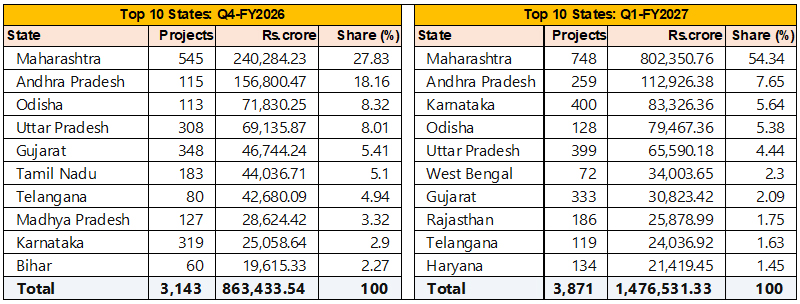
Andhra Pradesh retained the second position, though its investment declined to Rs 1,12,926.38 crore (7.65 percent share) from Rs 1,56,800.47 crore (18.16 percent share), a decline of 27.98 percent. Notable projects announced in the state during the quarter included the Artificial Intelligence Data Centre at Rambilli by Raiden Infotech India (Rs 21,400 crore) and the Pumped Storage Hydel Power project at Kadapa by Adani Hydro Energy Eleven (Rs 12,297 crore).
Karnataka recorded the sharpest improvement in ranking among the Top 5, moving to third position with Rs 83,326.36 crore (5.64 percent share) from ninth position with Rs 25,116.06 crore (2.91 percent share) in Q4-FY2026, a growth of 231.77 percent. The increase was supported by the Eastern Connectivity Tunnel at Bengaluru International Airport (Rs 16,500 crore, State Government) and the Aluminium Metallurgical & Downstream Processing Complex at Vasanthanarsapura by Jindal Aluminium (Rs 6,000 crore).
Odisha moved to fourth position with Rs 79,467.36 crore (5.38 percent share) from third position with Rs 71,830.25 crore (8.32 percent share) — investment rose in absolute terms by 10.63 percent, though its share declined as the national total grew faster. Key projects in the state included the Ultra Supercritical Coal Based Power project at Cuttack by Orissa Thermal Energy (Rs 18,450 crore) and the Integrated Steel Plant at Sambalpur by Shyam Metalics & Energy (Rs 7,580 crore).
Uttar Pradesh held fifth position, with investment at Rs 65,590.18 crore (4.44 percent share), broadly stable compared with Rs 69,135.87 crore (8.01 percent share) in Q4-FY2026, a decline of 5.13 percent. The Ghaziabad-Sitapur third and fourth railway line by Northern Railway (Rs 14,926 crore) was the largest project announced in the state during the quarter.
West Bengal entered the Top 10 at sixth position with Rs 34,003.65 crore (2.30 percent share), up from fourteenth position with Rs 11,350.30 crore (1.31 percent share) in Q4-FY2026, a growth of 199.58 percent, aided by the Solar Ingots, Wafers, Cells & Modules project by Vikram Solar (Rs 27,000 crore). Gujarat slipped to seventh position with Rs 30,823.42 crore (2.09 percent share), from fifth position with Rs 46,744.24 crore (5.41 percent share), a decline of 34.06 percent.
Rajasthan improved to eighth position with Rs 25,878.99 crore (1.75 percent share), from thirteenth position with Rs 13,282.04 crore (1.54 percent share), a growth of 94.84 percent. Telangana slipped to ninth position with Rs 24,036.92 crore (1.63 percent share), from seventh position with Rs 42,680.09 crore (4.94 percent share), a decline of 43.68 percent. Haryana entered the Top 10 at tenth position with Rs 21,419.45 crore (1.45 percent share), from fifteenth position with Rs 9,378.39 crore (1.09 percent share) in Q4-FY2026, a growth of 128.39 percent.
Compared with Q4-FY2026, the top-10 list changed in composition. Maharashtra, Andhra Pradesh, Odisha, Uttar Pradesh, Gujarat and Telangana continued in the top group. Karnataka moved up sharply from ninth to third. West Bengal, Rajasthan and Haryana entered the top-10 list. Tamil Nadu, Madhya Pradesh and Bihar moved out of the top-10 in Q1-FY2027.
Emerging Investment Districts Beyond Tier-I Cities
A notable trend during the period is the increasing flow of investments into districts outside India's traditional metropolitan centres.
Outlook
The outlook for fresh investment remained cautious. The previous two quarters had shown weakness across several major sectors, and Q1-FY2027 did not fully reverse that trend once the nuclear projects were excluded. Global uncertainty, disruption in crude oil and gas supplies, and pressure on exports of goods and services had affected investment decisions. Public reporting in early July 2026 indicated that the Strait of Hormuz situation remained fragile, with shipping recovery vulnerable to renewed incidents. This suggested that the external environment still required close monitoring.
If energy shipping stabilised and geopolitical tensions eased in the second quarter, the country might see a revival in private investment in the second-half of FY-2027. A more visible revival in private investment was likely to depend on lower uncertainty in energy supplies, improved export conditions, and a clearer project execution environment.
About Projects Today
Projects Today is India's largest online databank on new and ongoing projects in India. The website, launched on 8 September 2000, aims to provide the required foresight to its clients based on sectoral insights its research team possesses. The project-related information provides an invaluable marketing resource to assist the business development efforts of the organisations that focus on the new projects market. It is widely used by the project fraternity, primarily, as a business opportunity identifier.
Projects Today conducts Survey of Project Investment, at the end of every financial quarter to gauge the trends in projects investment in India by sectors, state, ownership, etc.
Disclaimer : The opinions expressed within this interview are the personal opinions of the interviewee. The facts and opinions appearing in the answers do not reflect the views of Indiastat or the interviewer. Indiastat does not hold any responsibility or liability for the same.
"Global Bond Index Inclusion Can Make Capital Inflows Durable"... Read more










.png)